What actually happens between a life event
Nobody explains this process to English speakers in plain language. So we will, from beginning to end. A few minutes of reading, and you will understand it better than most people who have already claimed.
Why refunds exist at all.
Your employer calculates tax monthly, as if that month were the whole year on repeat. Life does not repeat. You switch jobs. You have months without salary. A child is born. You finish a degree. You make pension deposits on your own. At the end of the year, the true calculation differs from the monthly assumption. When the difference is in your favor, the money does not come looking for you. It sits with the state, recorded against your ID number, until someone files.
Two plain terms, and then no more vocabulary. A closed year is a tax year whose numbers are final; those are the years a refund can come from. A Form 106 is the annual summary of salary and tax that every employer must give you. That is the whole dictionary.
The events that create refunds.
An event does not promise a refund. It creates a reason to check.
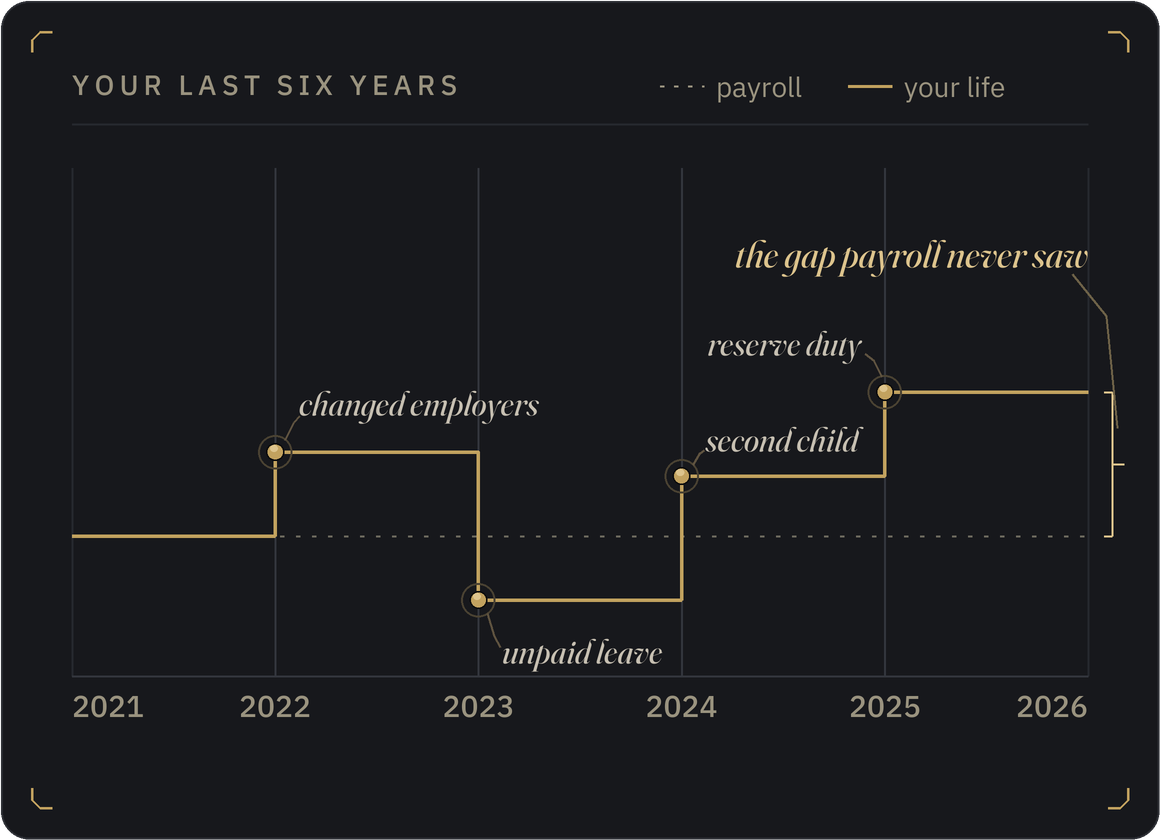
You changed jobs, or had a gap between jobs. Two employers each taxed you as if they were the only one, or months without work left credit unused.
A child was born. Your credit points changed in the middle of a year that payroll treated as uniform.
You finished a degree or certification. Completion entitles you to credit points in the years that follow. Payroll rarely knows.
You made aliyah. New immigrants receive substantial credit points for several years. Applied late or partially, the difference stays with the state.
You took unpaid leave. The months you did earn were taxed on full-year assumptions.
You served in the reserves. Army payments and salary interact in ways payroll systems frequently assume wrong.
You made private pension or study-fund deposits. Deposits your employer never saw entitle you to relief your employer never applied.
You received severance. Parts of severance are exempt. The split is often computed against you by default.
One event on this list is enough to justify the two-minute check.
The documents, in plain terms.
Almost everything here is retrievable. Part of our work is retrieving it.
A Form 106 from each employer, for each year being checked. Employers are required to provide them, and lost ones can be replaced.
Your ID and bank details, so the state can pay you directly.
Evidence of the event: a degree certificate, an aliyah certificate, a reserve-duty confirmation, pension deposit confirmations.
If a document is missing, that is normal, not disqualifying.
What happens behind the scenes.
What the CPA actually does
The CPA rebuilds each year as it really happened: every employer, every credit point you were entitled to, every deposit and every exempt portion. The rebuilt year is compared with what was actually withheld from your salary.
Where the state holds the difference, an annual return is filed for that year. One return per year, each under the professional responsibility of a licensed CPA firm, and nothing is submitted before you approve what we found.
What the state does
The Tax Authority processes each filed year. Sometimes it asks a question; answering is our job. When a year is approved, the refund is paid by the state directly into your bank account, with interest and inflation linkage added by law.
The money never passes through us. The state pays you; only then do we invoice our share.
How long each stage takes.
The check, then our answer
Two minutes for the check. A clear first answer from us within one to two days.
Gathering documents
Days to about three weeks, depending on what must be retrieved.
Filing
Prompt, once the picture of a year is complete.
The state pays
Timing varies by year and case; we tell you what to expect before anything is filed. The wait itself earns interest and linkage by law.
The window closes every January.
Refunds reach back six closed years, and every January the oldest year expires forever. In 2026 the year 2020 can still be claimed. In January 2027 it cannot. Waiting does not pause the clock; it feeds it.
Here is what you should do.
List your last six years. If a single event from the list above appears in them, take the two-minute check now. The window closes a year at a time, and checking costs nothing: no documents, no commitment, and no fee unless money is actually recovered. If we see no meaningful potential, we tell you and stop. If we see it, you already know the whole process that follows, because you just read it.
What happened in your six years?
Tick every event that happened in your years. Two minutes, no documents.